YouTube Watch Hours: What Ads Can and Cannot Buy
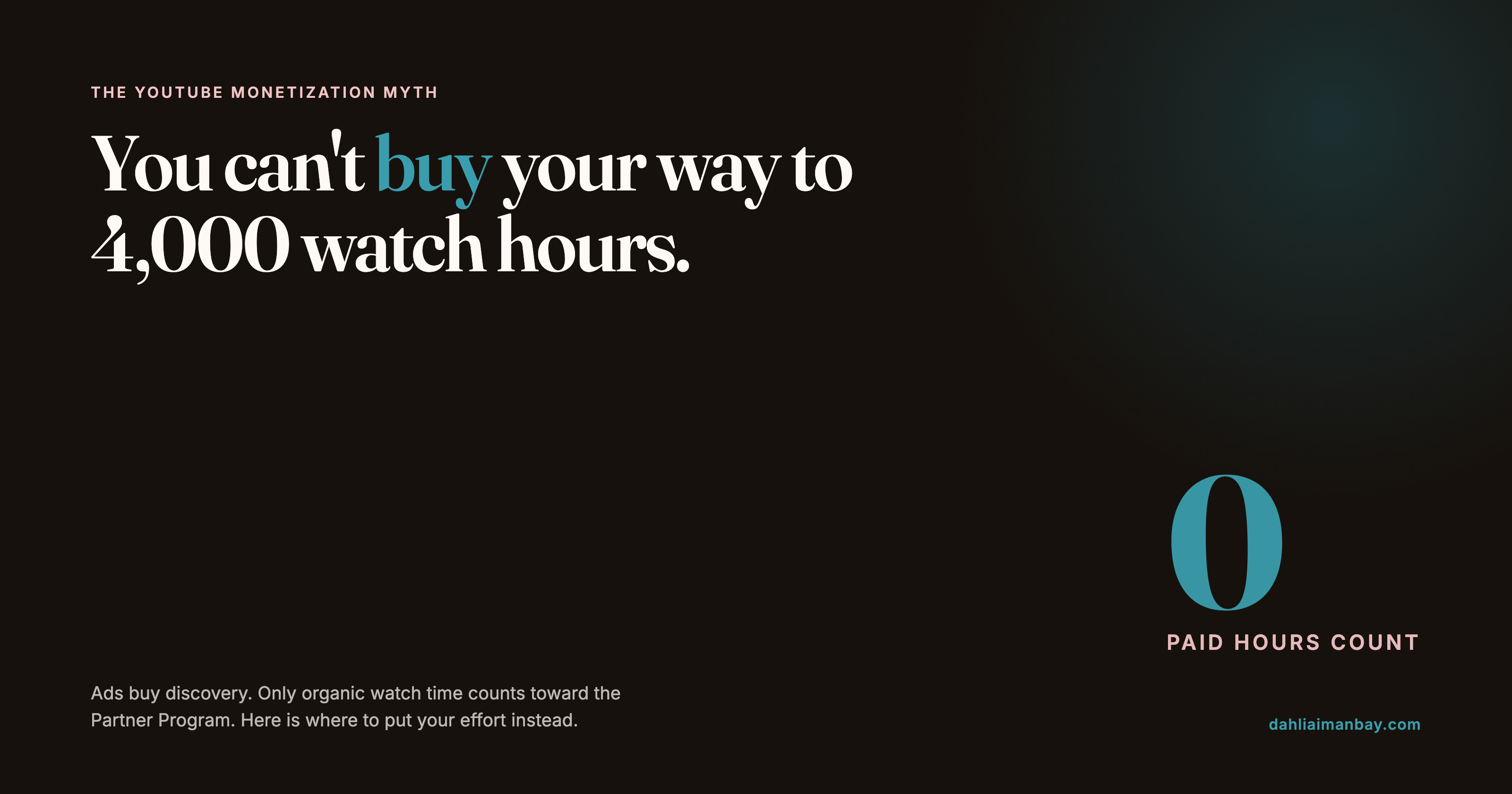
The short version: You cannot buy your way to YouTube monetization. The Partner Program's 4,000 valid public watch hours must come from organic viewing, and YouTube explicitly excludes watch time driven by paid promotion. Ad spend is a discovery tool: it puts your video in front of new people, but the hours it generates do not count toward the threshold. Build monetizable hours with organic content, then use paid ads to widen the top of the funnel. Get those two jobs confused and you will burn a budget with nothing to show for it.
A creator asked us a version of a question we hear a lot: "If I run YouTube ads on my videos, can I hit 4,000 watch hours faster?" It is a reasonable assumption. Ads drive views, views mean watch time, watch time is what the Partner Program counts. The logic looks clean. It is also wrong, and the gap between that assumption and how YouTube actually counts is where a lot of small creators and small-business channels quietly waste money.
We work on content systems, not vanity metrics, so before we set up any spend we go to the primary source and read exactly what qualifies. Here is what we found, what happened when we ran a real campaign for a client, and how we now split organic from paid so a channel actually reaches monetization. Our founder Dahlia wrote up the same lesson from a first-person angle after running two campaigns on her own channel.
The rule almost everyone gets wrong
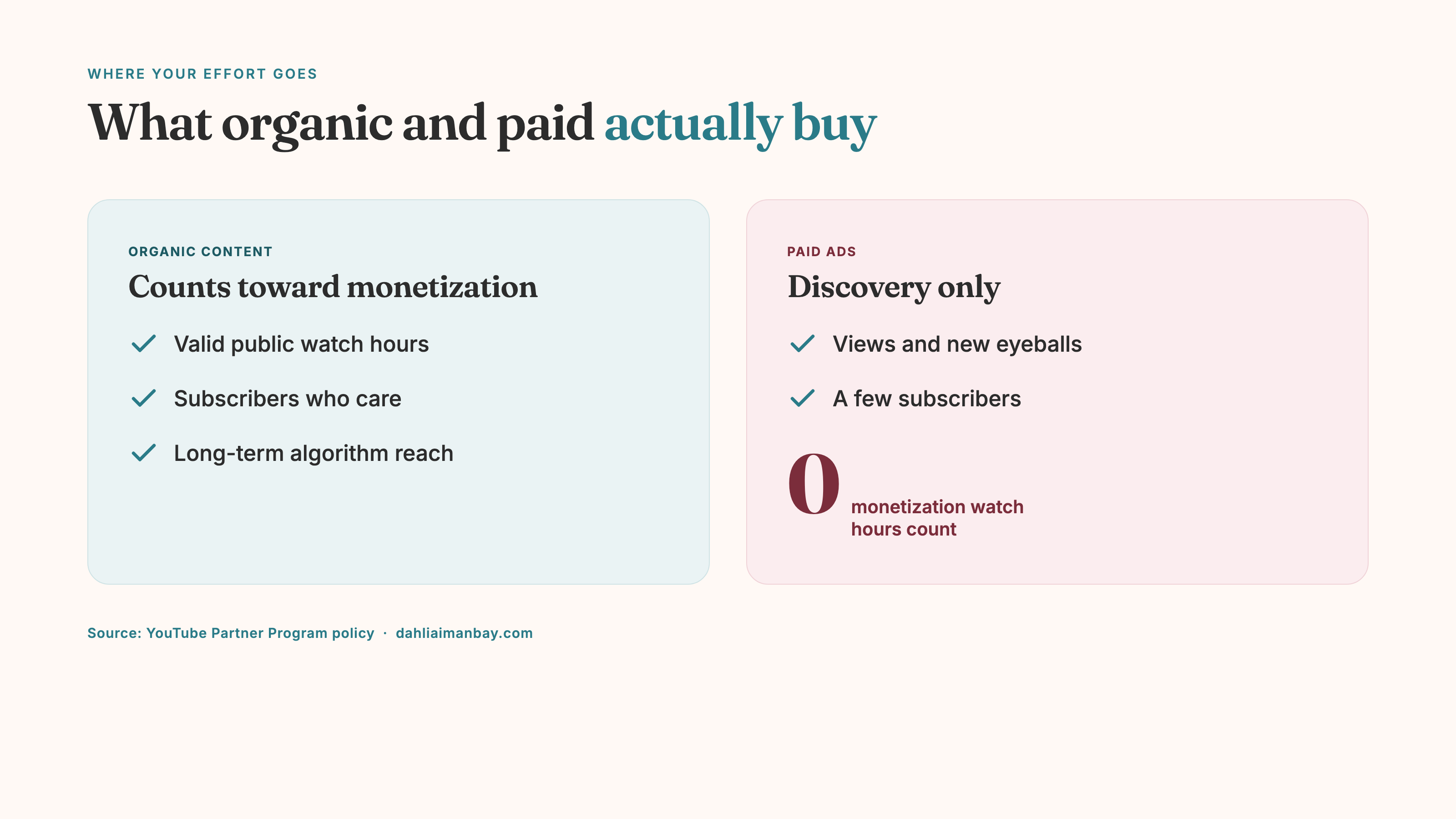
To join the YouTube Partner Program on the long-form route, a channel needs 1,000 subscribers plus 4,000 valid public watch hours in the past 12 months (or 1,000 subscribers plus 10 million valid public Shorts views in the past 90 days). The word doing the heavy lifting is valid. YouTube's own eligibility guidance and the Google Ads Help community are consistent on this point: watch time that comes from ads or other paid promotion does not count toward the 4,000 hours. Neither does watch time from content that is set to private, unlisted, or deleted.
So a promoted view can absolutely raise your public view count and your reach. What it cannot do is move the one number that unlocks monetization. That is by design. YouTube wants the threshold to represent genuine audience demand, not purchased attention, because the whole point of the bar is to prove a channel can hold real viewers before it starts sharing ad revenue.
You cannot buy your way to monetization
Paid promotion grows your view count and your audience. It does not add to the 4,000 valid public watch hours the Partner Program requires. Only organic watch time qualifies. Treat ads as a way to be discovered, never as a shortcut to the threshold.
What actually happened when we ran the campaign
In our client work we set up a YouTube campaign to grow a channel's reach, and the campaign type taught the lesson better than any policy page could. When the objective is built around clicks and conversions, which is how a Demand Gen campaign is structured, the system optimizes for the action, not for sustained viewing. It found people likely to click. It spent the budget. And it produced almost no watch hours, because watch time was never what it was told to maximize.
That is the trap in one sentence: the pattern we see is creators and clients assuming ad spend builds monetization hours, when the campaign objective they picked was never optimizing for watch time in the first place. If your goal is watch time, a Demand Gen campaign is the wrong tool, and even the right tool still will not credit those hours toward the 4,000. Paid is for discovery. Organic is for the threshold. (Results may vary; campaign behavior depends on objective, audience, and creative.)
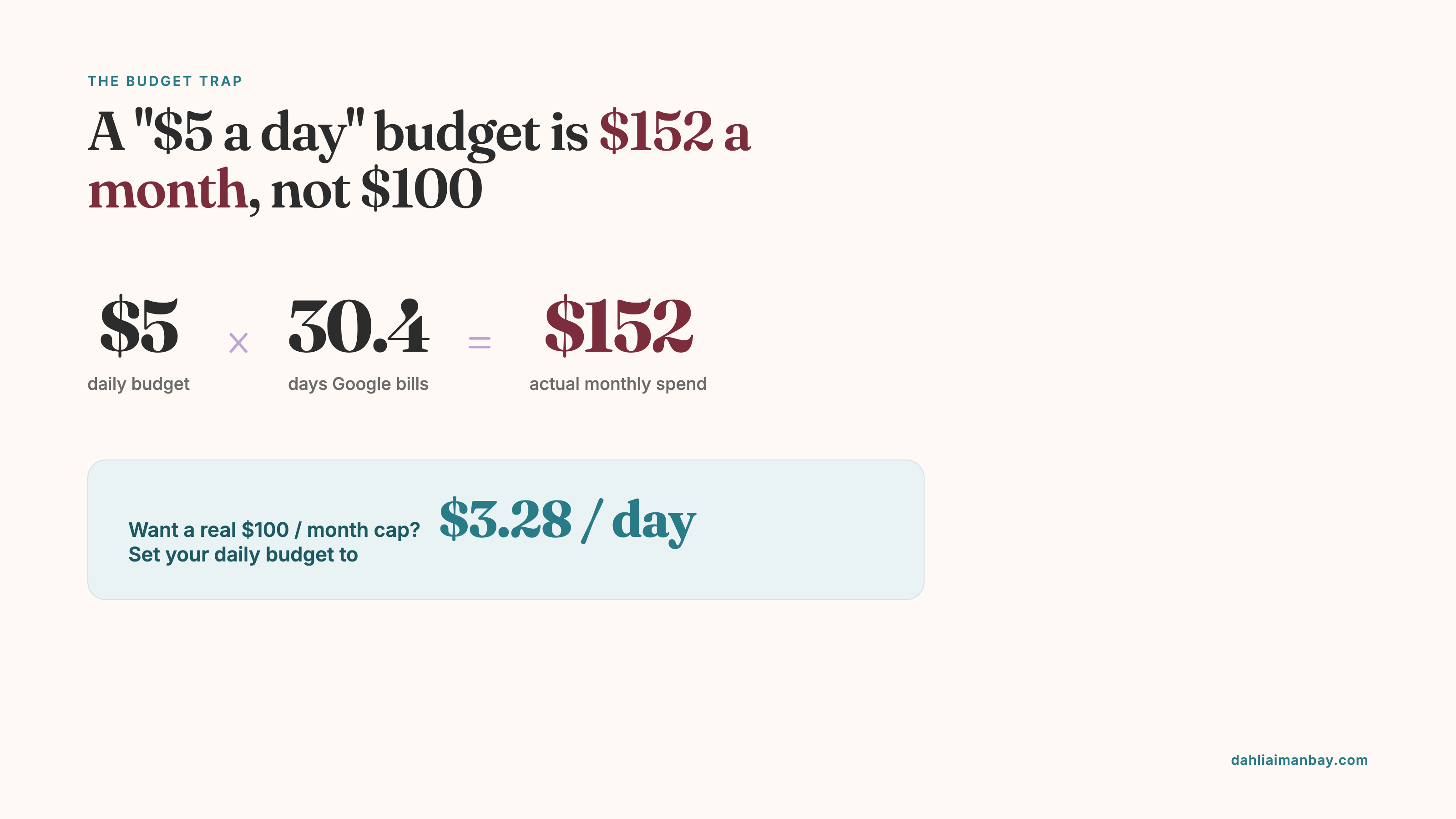
There is a budget trap sitting right next to the campaign trap. Google Ads does not cap your monthly spend at daily budget times 30. It multiplies your average daily budget by 30.4, the average number of days in a month. So a "$5 per day" budget can bill up to about $152 per month, not $150 and definitely not $100. Daily spend runs over on busy days and under on slow ones, but the monthly ceiling follows the multiplied number. If you want to hold spend near $100 per month, set the daily budget to roughly $3.28.
Section 1: Organic tactics that build monetizable watch hours
This is the work that actually counts toward the 4,000. None of it is exotic. It is a repeatable system, and consistency beats intensity every time.
- Publish 8 to 12 minute videos in niches your audience already searches for and watches. Long enough to accrue real minutes, short enough to hold attention.
- Double down on your top performers. When one video outpaces the rest, make three more like it instead of chasing a new idea.
- Repurpose winning Shorts into long-form. A Short that pops is a validated hook. Turn it into an extended tutorial or a story-style deep dive, the same way we run our content repurposing system.
- Open with a 30-second hook that states the payoff, cue viewers to watch to the end, and use end screens to send them straight into the next video.
- Build themed playlists with Play All so one click becomes a long binge session, which is how casual viewers turn into watch hours.
- Livestream on a schedule. Q&A, tutorials, and behind-the-scenes sessions run long, and long sessions add watch hours quickly.
- Do the SEO basics on every upload: front-load the keyword in the title, write a real description, and add tags. Tools like TubeBuddy and vidIQ help you find terms that mix trending and evergreen demand.
- Post 2 to 3 quality Shorts a day with trending sounds and captions on screen early, and use them as a funnel into your long-form catalog. Shorts also open the alternate Partner Program path: 10 million valid public Shorts views in 90 days.
The through-line is that every one of these tactics earns attention rather than renting it. In the channels we have helped structure this way, the compounding effect shows up in the playlist and end-screen data first: viewers moving from one video to the next is what turns a catalog into watch hours. [PLACEHOLDER: Dahlia adds real metric from a channel she has grown, results may vary.]
Section 2: Paid ads for discovery only
Paid still has a job. It just is not the job most people hand it. Use ads to solve a cold-start problem, to get your best organic video in front of people who have never heard of you, and then let the organic machinery do the counting. When the goal is watch time and discovery, here is how we set paid up.
- Run a Video views or awareness campaign, which serves skippable in-stream, in-feed, and Shorts placements. Do not use Demand Gen when the objective is watch time.
- Build custom segments that target people who searched a competitor or creator name, or who browse competitor sites, under Tools, then Shared library, then Audience manager, then Custom segments.
- Serve on Shorts with mobile-only delivery, a 9:16 vertical cut, and a runtime under 60 seconds.
- Research competitor ads in the Google Ads Transparency Center before you write your own, so you enter a proven lane instead of guessing.
- Do the budget math up front: daily budget times 30.4 equals your monthly ceiling. A roughly $100 per month cap is about $3.28 per day.
- Warm cold audiences with video-views campaigns first, then retarget the warmed audience with conversion campaigns once they know you.
- Optimize on retention and view duration, not raw view count, so you are paying for people who actually watch.
- The view counter looked great. One creator who documented the experiment promoted a video with a Google Ads Video views campaign, and views jumped from about 300 to 1,200 in four days.
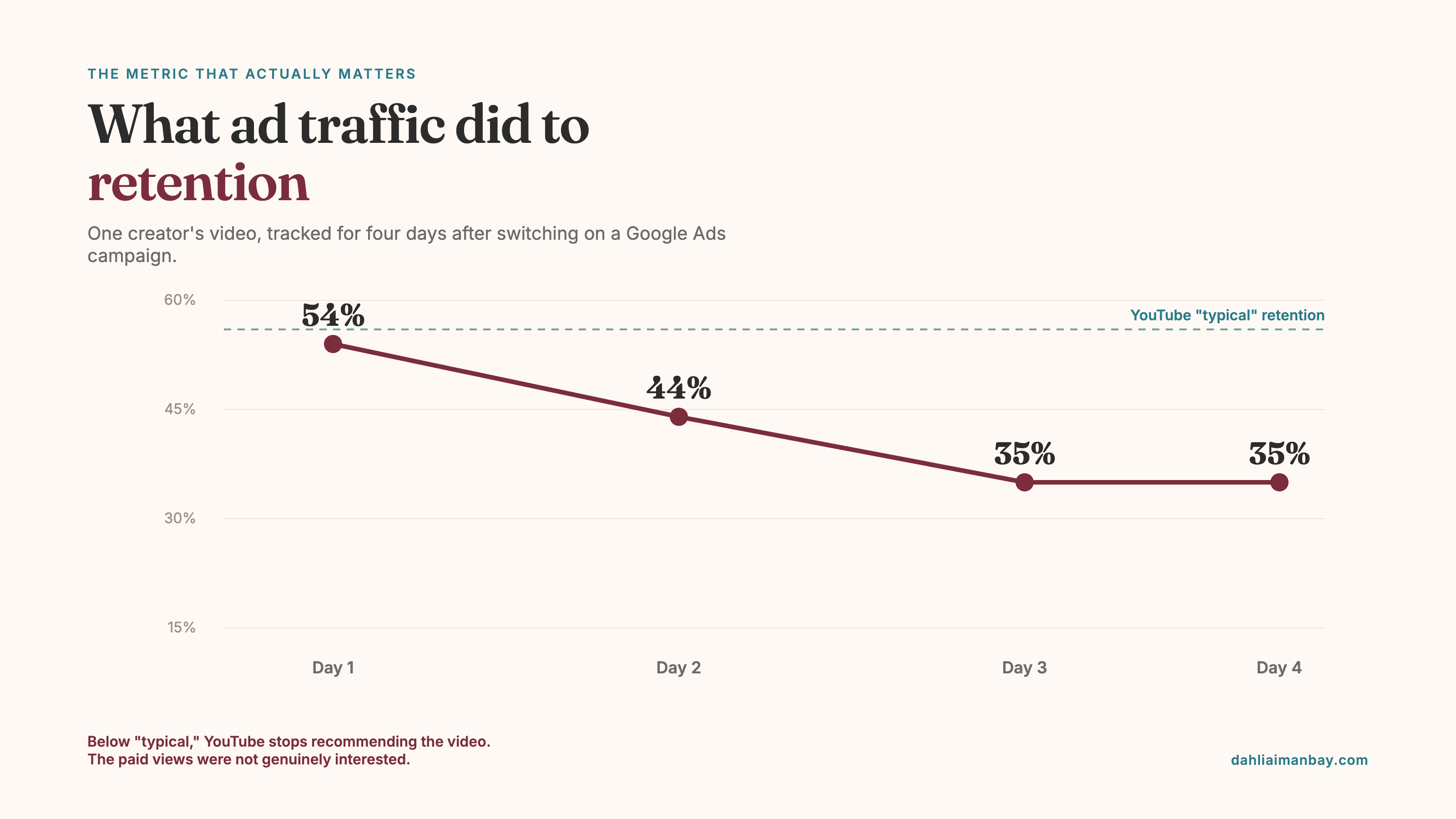
- Retention told the real story. It fell from 54%, YouTube's typical mark for that video, to 44% on day two, then to about 35%, below typical, on days three and four, because the ad traffic was not genuinely interested.
- The first 30 seconds are the decision window. Low retention there signals YouTube that viewers do not care, so the video can get buried in the algorithm.
- It was not a total loss. She still gained 6 subscribers from the campaign, double the 3 she had from organic.
- The honest conclusion. The campaign hurt the video more than it helped, because views without interest do not build a channel. It is the clearest case we know for judging ads on retention and genuinely interested viewers, not the raw view counter.
Credit where it is due: much of this paid structure tracks with what creators like Promogod, Ric Zog Digital, and DCYPHER Studios teach about running YouTube ads for channel growth. We tested it against a real objective and it holds up, as long as you remember the boundary: these campaigns buy discovery, not the 4,000 hours.
Organic content earns the watch hours that unlock monetization. Paid ads earn the audience. Confuse the two and you pay for attention that will never count.
How we split the two in a real plan
When we map a channel to monetization, the split is simple. Organic content is the engine that produces qualifying watch hours, and it runs continuously. Paid is a targeted assist layered on top of the videos already proving they can hold an audience, so ad spend amplifies a winner instead of propping up a video that does not retain. We measure the two separately: organic against valid public watch hours and subscriber growth, paid against retention, view duration, and cost per new viewer. Judged on the right metric, each does its actual job.
Key takeaways
- The 4,000 watch hours must be organic. Paid and promoted watch time is excluded and will not count.
- A Demand Gen campaign optimizes for clicks, not viewing, so it can spend a full budget while adding almost no watch hours.
- Build hours with 8 to 12 minute videos, binge playlists, livestreams, repurposed Shorts, and basic upload SEO.
- Use paid Video views or awareness campaigns for discovery, targeting custom segments and optimizing on retention.
- Budget math: daily budget times 30.4 is your monthly cap, so $5 per day is about $152 per month, and a $100 cap is about $3.28 per day.
- There is a second route to the Partner Program: 10 million valid public Shorts views in 90 days.
Frequently Asked Questions
Do Google Ads count toward the 4,000 YouTube watch hours?
No. The YouTube Partner Program requires 4,000 valid public watch hours in the past 12 months, and watch time driven by Google Ads or any paid promotion is explicitly excluded. Paid views can raise your view count and send new people to your channel, but those promoted hours do not count toward the 4,000 you need to monetize. Only organic watch time qualifies.
Why does a Demand Gen campaign produce almost no watch hours?
A Demand Gen campaign optimizes for clicks and conversions, not sustained viewing. In client work we set up a YouTube campaign and saw that when the objective is clicks, the system serves for action rather than watch time, so it can spend the full budget while adding almost no watch hours. If watch time is the goal, use a Video views or awareness campaign instead, and optimize on retention and view duration rather than raw views.
How much does a $5 per day YouTube ad budget actually cost per month?
About $152, not $150 and not $100. Google Ads multiplies your average daily budget by 30.4, the average number of days in a month, so a $5 daily budget bills up to roughly $152 per month. To cap spend near $100 per month, set the daily budget to about $3.28. Daily spend can run over on high-traffic days and under on slow ones, but the monthly total stays within the multiplied cap.
What is the fastest legitimate way to reach 4,000 watch hours?
Publish 8 to 12 minute videos in a niche your audience already searches for, double down on whatever performs, turn top Shorts into extended tutorials, and group everything into binge-friendly playlists with Play All. Livestreams add watch hours quickly because sessions run long. There is also an alternate path to the Partner Program: 10 million valid public Shorts views in the past 90 days instead of the watch-hour route.
Sources & Credit
- YouTube Help. YouTube Partner Program overview & eligibility, the primary source for the 4,000 valid public watch hours requirement and the paid-promotion exclusion.
- Google Ads Help Community. Discussions on promoted watch time and Partner Program eligibility, confirming that ad-driven watch hours do not count toward the threshold.
- Google Ads Help. About average daily budgets, on the 30.4 monthly multiplier.
- Paid-tactic structure credited to YouTube educators Promogod, Ric Zog Digital, and DCYPHER Studios.
Want a growth engine that actually counts?
We map channels to monetization by separating the organic work that builds watch hours from the paid work that builds audience, then run both on the right metric.
Book a Strategy Call↗